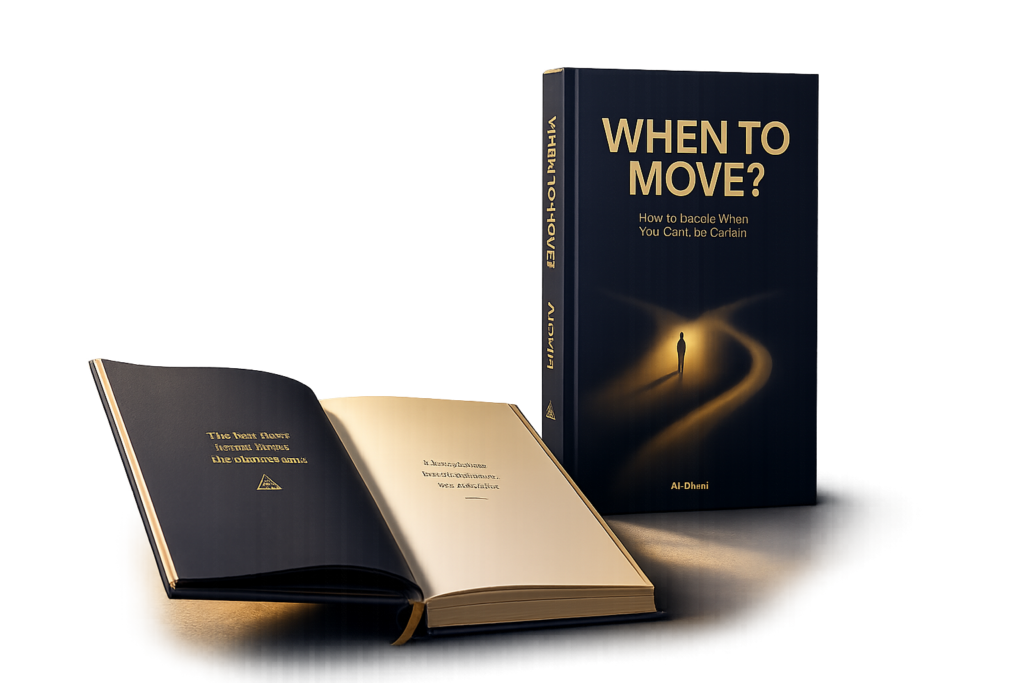
A BOOK BY ALI DHAINI
When to
Move?
10 Tools for Making Decisions Without Knowing Everything
ABOUT THE BOOK
About When To Move?
How many decisions have you postponed because you didn’t feel ready? How many opportunities have you missed while waiting for more information, the right time, or a guarantee that never came?
When To Move? by Ali Dhaini is a practical book about making decisions without complete certainty. It offers ten tools to help you assess risk, compare your options, and recognise when acting becomes better than waiting.
This book doesn’t promise a life without fear or a perfect outcome. It helps you distinguish wise waiting from hesitation—and move forward with what you know now.

A THOUGHT TO CARRY
“You don’t need certainty to move forward.”
READ A SAMPLE CHAPTER
Step inside When To Move?
Explore the opening chapter of Ali Dhaini’s book on making decisions without certainty, and discover whether it speaks to you.

THE FIRST PRINCIPLE
Not making a decision is a decision too.
Imagine you are standing before two roads. The first is unknown. So is the second. You stay where you are because you are afraid of choosing the wrong road.
A day passes. Then a week. Then a month. Then a year.
Eventually, you realize that without noticing it, you chose a third road. You chose to stay where you were.
We do this all the time. We stay in jobs we don’t like. We remain in relationships we know are hurting us. We postpone projects we believe in. And we put off important decisions because we are afraid they might turn out badly.
But we forget something simple:
Postponement itself has a cost.
If someone offered you an investment that required a thousand dollars, you would calculate the potential profit and loss. If you were considering buying a house, you would calculate the payments, the interest, and the risks.
But how often do you calculate the cost of not acting? How often do you ask yourself:
What will I lose if I act?
And what will I lose if I don’t?
Most people answer the first question. They forget the second.
✦
Years ago, there were two friends who worked at the same place. Both dreamed of starting a business of their own.
The first decided to start. The second decided to wait until he felt completely ready. He read countless books. He watched hundreds of videos. He took dozens of courses. And every time, he told himself:
“I still need to know more.”
Years later, the first friend had made many mistakes, lost money, and learned a great deal. The second had gained only one thing:
More time spent waiting.
The human brain dislikes loss. In fact, studies suggest that the pain of losing can often feel stronger than the pleasure of gaining. That is one reason the brain tries to avoid risk.
But the problem is that the brain makes the same mistake again and again:
It calculates the cost of action, but not the cost of inaction.
✦
A SIMPLE EXERCISE
Let’s try something simple.
Take a sheet of paper and divide it into two columns. In the first column, write: What will I lose if I act? In the second, write: What will I lose if I don’t act?
Then give each item a score from zero to ten.
Exercise note: Use your paper to list the possible losses under each heading and record a score beside each one. Total the scores separately.
Result: Action ______ / Inaction ______
Add up the scores in each column. The result does not automatically determine the decision; it simply reveals where the greater cost appears to lie based on your current assessment.
You will often discover that the picture you had been looking at was incomplete. And that brings us to the first rule of this book:
Don’t compare action with perfection. Compare the cost of action with the cost of inaction.
✦
CHAPTER ONE TOOL
Before making any decision, ask yourself these questions:
What will I gain if I act?
What will I lose if I act?
What will I gain if I don’t act?
What will I lose if I don’t act?
What will change after one month?
What will change after one year?
What will change after five years?
✦
SUMMARY
Not every action is a good decision. But inaction is not necessarily a safe decision either.
And often, the right question is not:
Should I act?
The better question is:
What will it cost me to stay where I am?
✦
PRACTICAL CASE — THE JOB OR THE BUSINESS?
A thirty-eight-year-old man has been working in a stable job for twelve years. He earns a decent salary—enough to cover his family’s basic needs.
But for years, he has felt that he is on a path that does not reflect who he is, and that his true capabilities go far beyond what he does every day.
He has an idea for a small business that he believes in, and he has solid experience in the field. But he is afraid to leave his job because the decision could affect his wife, his children, his savings, and his entire future.
Every night, he asks himself the same question:
Should I stay in my job, or leave and start my own business?
This is the question that will stay with us through Chapter Ten.
The man believed he had not made a decision yet. But then he realized something important:
He had already been making one. He had been choosing to stay.
Every morning, he woke up at the same time, went to the same place, repeated the same routine, and postponed the same question until another day.
He had assumed that all the risk lay in leaving. But he had never asked himself the opposite question:
What is the cost of staying?
✦
So he used the first tool in this book:
THE COST TABLE
He compared the cost of staying with the cost of leaving across five areas:
Money: Staying offered greater stability; leaving involved greater risk.
Time: Staying meant losing additional years; leaving offered a new opportunity.
Mental well-being: Staying meant ongoing pressure; leaving meant temporary stress.
Family: Staying offered temporary stability; leaving could bring changes.
Achieving his ambition: Staying offered a lower probability; leaving offered a higher probability.
He then moved to the next questions:
What will I lose if I leave?
What will I lose if I stay?
His answers looked like this:
If I leave:
I may lose my salary.
The business may fail.
I may have to start over.
If I stay:
I may lose more years of my life.
I may lose my motivation and energy.
I may regret it later.
The opportunity may disappear entirely.
That was when he began to realize that the situation was more
complicated than he had thought.
He was not comparing risk with safety. He was comparing two different
kinds of risk.
✦
Perhaps the real question isn’t: Should I leave? It’s: What price will I pay if
I stay?
The sample ends here. Chapter one runs another eleven pages.
Order the bookFIVE IDEAS FROM THE BOOK
Making decisions without certainty
Explore five of the ten principles in When To Move?—from recognising the cost of inaction to knowing when it’s time to act.
The Cost of Inaction
Not making a decision is a decision too.
Waiting can feel safe, but it carries its own risks. Consider what you might lose by staying where you are.
Enough Evidence
You don’t need complete evidence to decide.
Separate what you know from what you assume, and ask whether you have enough information to take the next step.
Understanding Fear
Not every fear is a sign of danger.
Learn to distinguish a real threat from the discomfort of facing something unfamiliar.
Comparing Your Options
There is no perfect option.
Every choice involves trade-offs. Compare the benefits, risks, and compromises that matter most to you.
Knowing When to Act
Sometimes waiting costs more than trying.
Recognize when further delay adds little value and taking action becomes the better choice.
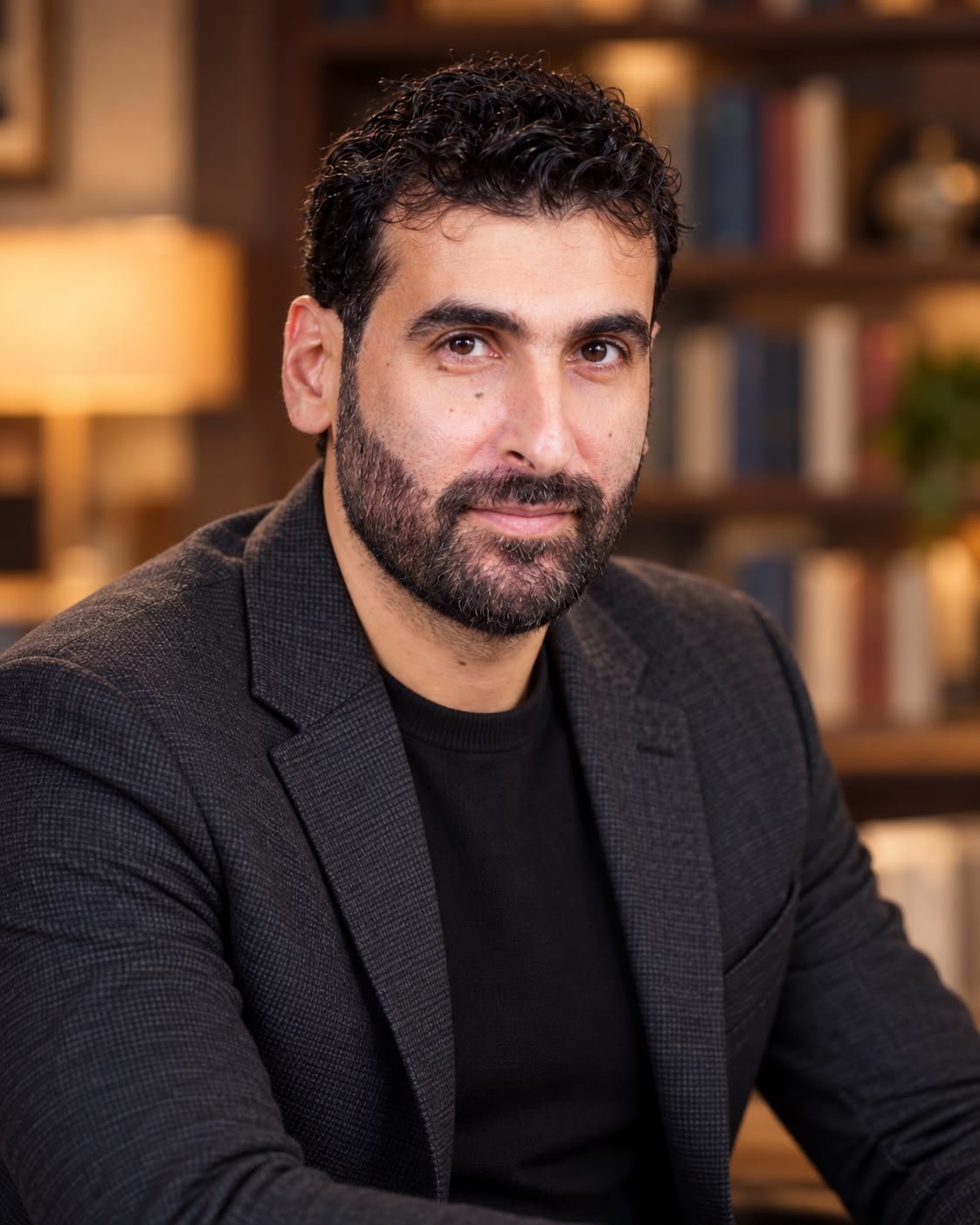
About Ali Dhaini
Ali Dhaini is an author, entrepreneur, and international boxing coach whose professional experience spans more than twenty-three years across sports, education, and business building.
He served as a coach for the Lebanese National Boxing Team and earned a one-star international coaching certification from the International Boxing Association (AIBA).
He taught biomechanics, alongside his experience in entrepreneurship and business management.
These different paths and the successes, failures, and decisions made along the way, often under conditions of incomplete information—led him to focus on one practical question: How does a person make a decision when they do not know everything?
That question became the foundation of his first book, When To Move? — 10 Tools for Making Decisions When You Don’t Know Everything.
Early readers
I read it in one sitting, then spent a week rereading the third chapter. It gave me language for a decision I had been avoiding for two years.
Most books on deciding hand you a framework. This one hands you a mirror, and then a deadline.
The chapter on reversible decisions changed how our team works. We stopped debating the cheap choices and started shipping them.
GET YOUR COPY
Order When To Move?
Discover ten practical tools for making decisions without knowing everything. Choose your preferred edition and start reading.